EN
EN

Industrial noise is one of the most persistent challenges in manufacturing environments, and the mechanical drive system is often the primary source. A poorly selected or worn v-belt can generate significant vibration and acoustic disturbance that affects worker safety, equipment longevity, and overall production quality. Upgrading to a high-performance v-belt is one of the most effective and cost-efficient steps a facility can take to address these challenges directly. Understanding why the v-belt plays such a central role in noise management helps engineers and procurement teams make better-informed decisions.
A high-performance v-belt is engineered with precision geometry, advanced materials, and consistent tension properties that standard v-belt options simply cannot match. Whether applied in packaging machinery, printing equipment, or cutting process lines, a quality v-belt delivers measurably quieter operation from the first installation. This article explores the specific noise-reduction benefits that a well-designed v-belt system provides, the mechanical reasons behind those benefits, and the practical considerations for selecting the right v-belt for your application.
How V-Belt Design Directly Affects Noise Output
The Role of V-Belt Geometry and Material Composition
The cross-sectional geometry of a v-belt determines how evenly it seats within the pulley groove. A precisely manufactured v-belt maintains full, uniform contact across the groove flanks, which eliminates the slippage and micro-vibration that cause high-frequency noise. When a v-belt is slightly undersized or irregularly shaped, it rocks within the groove, creating a repetitive impact pattern that builds into audible noise over time. A high-performance v-belt with tight dimensional tolerances avoids this problem entirely.
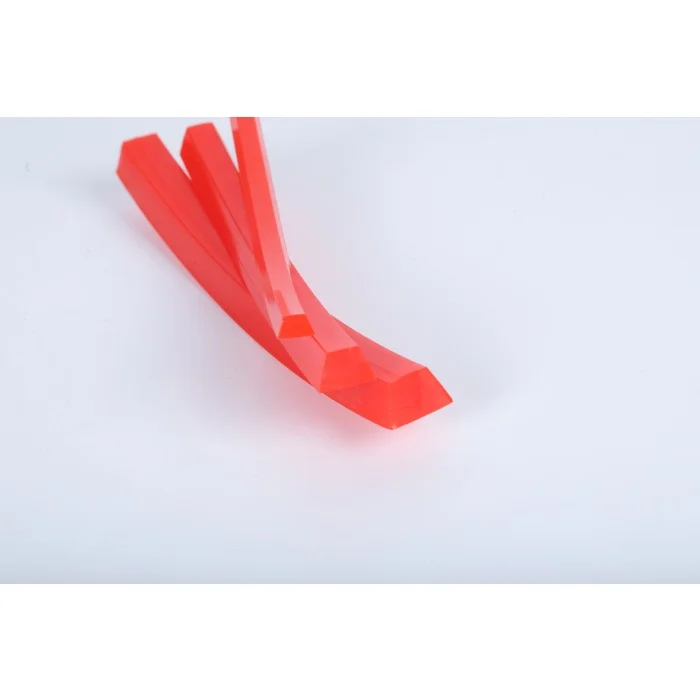
Material selection is equally important to v-belt noise performance. A polyurethane v-belt, for example, offers a higher damping coefficient than traditional rubber v-belt constructions. This means the v-belt absorbs mechanical energy rather than transmitting it as vibration into the frame and surrounding structure. The result is a noticeably quieter v-belt drive system that remains quieter even under variable load conditions. Engineers specifying a v-belt for noise-sensitive environments consistently prefer polyurethane v-belt compounds for this reason.
Tension Consistency and Its Impact on V-Belt Acoustics
Inconsistent tension is one of the leading causes of v-belt noise in industrial drives. A v-belt that fluctuates in tension during operation causes the pulley contact angle to vary, which generates a characteristic slapping or squealing sound. A high-performance v-belt maintains more consistent tension across its operating range because of its superior cord construction and elastic memory. This v-belt stability translates directly into reduced acoustic output at all operating speeds. Facilities that switch from a conventional v-belt to a precision-engineered v-belt often report immediate and sustained noise reduction without any other changes to the drive system.
Operational Benefits Beyond Noise Reduction
How a Quieter V-Belt Signals Better Mechanical Health
Noise reduction is not just a comfort improvement; it is a reliable indicator of overall v-belt system health. A v-belt that runs quietly is a v-belt that is running efficiently, with minimal energy loss to vibration and heat. Conversely, a noisy v-belt is almost always a v-belt that is consuming more power than it should, running hotter than ideal, and wearing faster than expected. By investing in a high-performance v-belt, facilities simultaneously reduce noise and extend the service interval of the entire v-belt drive assembly.
The connection between v-belt noise and maintenance costs is well understood in industrial maintenance practice. A noisy v-belt is a warning signal that technicians have learned to take seriously. When a v-belt begins to squeal, slap, or vibrate audibly, it typically indicates that v-belt replacement or re-tensioning is overdue. A high-quality v-belt delays the onset of these symptoms significantly, reducing the frequency of v-belt-related maintenance interventions and the associated downtime costs. In high-throughput environments, fewer v-belt maintenance stops translate directly to higher output and lower operating expense.
V-Belt Noise Reduction in Sensitive Production Environments
Certain production environments have especially strict requirements for v-belt noise levels. Printing and packaging lines, for example, operate in facilities where noise regulations directly affect worker health compliance and product quality inspection accuracy. A high-performance v-belt on these lines ensures that background mechanical noise does not interfere with quality control processes or trigger regulatory concerns. Similarly, cutting process equipment benefits greatly from a well-tensioned, low-noise v-belt because vibration in the v-belt drive can translate into micro-movement at the cutting head, affecting cut precision. Choosing the right v-belt for these applications is therefore both a noise management decision and a quality assurance decision.
Selecting the Right V-Belt for Maximum Noise Reduction
Key Criteria for Choosing a High-Performance V-Belt
When selecting a v-belt for noise-sensitive applications, engineers should evaluate several key criteria. The v-belt profile must match the pulley groove geometry precisely, since even a minor mismatch increases v-belt noise. The v-belt material should offer high damping characteristics, with polyurethane v-belt compounds being among the most effective for noise control. The v-belt cord construction should provide high modulus and low elongation to maintain consistent tension, and the v-belt surface finish should be uniform to prevent stick-slip behavior during operation. Reviewing these v-belt parameters before selection prevents costly noise problems after installation.
Installation and Alignment Practices That Protect V-Belt Performance
Even the highest-quality v-belt will produce excessive noise if installed incorrectly. Pulley misalignment is one of the most common causes of v-belt noise complaints in the field. When pulleys are not parallel, the v-belt runs at an angle within the groove, creating uneven wear and vibration. Proper v-belt tensioning is equally critical; an over-tensioned v-belt stresses bearings and creates high-pitched noise, while an under-tensioned v-belt slips and squeals. Taking the time to align pulleys carefully and set v-belt tension to the manufacturer's specification ensures that the v-belt delivers its full noise-reduction potential from day one.
FAQ
Why does a high-performance v-belt reduce noise more effectively than a standard v-belt?
A high-performance v-belt uses tighter dimensional tolerances, advanced damping materials, and superior cord construction. These features allow the v-belt to maintain consistent contact and tension, which are the two primary drivers of v-belt noise. A standard v-belt typically lacks these properties and degrades more quickly, increasing noise over time.
How often should a v-belt be inspected to maintain low noise levels?
A v-belt should be visually inspected at every scheduled maintenance interval, typically every 500 to 1000 operating hours depending on the application. Any signs of v-belt cracking, glazing, or uneven wear should prompt immediate v-belt replacement. Proactive v-belt inspection prevents noise problems from developing and protects other drive components.
Can a polyurethane v-belt be used in high-temperature cutting and printing applications?
Yes. A polyurethane v-belt is well-suited for high-temperature environments found in cutting and printing equipment. The v-belt material resists heat-related hardening and maintains its damping properties at elevated temperatures, ensuring that the v-belt continues to deliver low-noise performance even under demanding thermal conditions.